


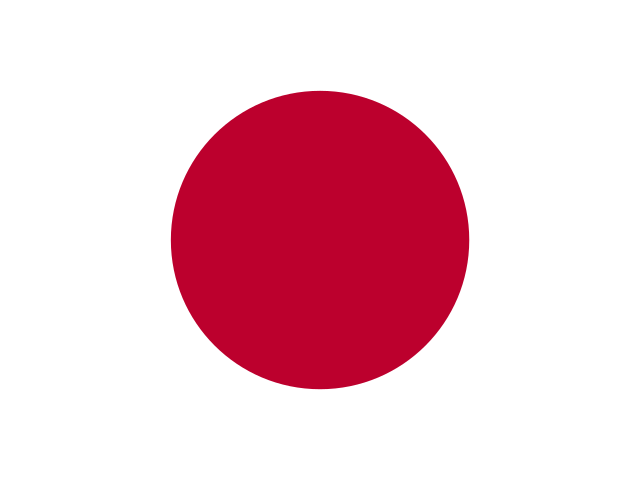
MIRAI – The Japan Exchange Programme for Students
One week in Japan, discussions with students and experts, visits to universities, research institutions and companies: the MIRAI programme of Japan’s Ministry of Foreign Affairs is more than a study trip. It is designed to connect young people – while also demonstrating how personal encounters can become part of international relations. Applications for the 2026/2027 programme are currently open to students enrolled at German universities.
YOUTH & POLITICSJAPAN IN FOCUS
8/19/20264 min read


Foreign policy does not take place only at government meetings or in embassies. Relationships between countries also develop where people meet, discuss ideas and share experiences.
This is precisely the approach behind MIRAI. The name stands for “Mutual Understanding, Intellectual Relations and Academic Exchange Initiative.” Japan’s Ministry of Foreign Affairs invites students from Europe and other regions to take part in an approximately one-week exchange programme in Japan.
The programme includes lectures and discussions as well as visits to universities, research institutes, companies, and historical and cultural sites.
Its stated objective goes beyond simply introducing participants to Japan. MIRAI aims to promote mutual understanding, encourage intellectual exchange and create networks among young people.
Three programmes are open to students from Germany
For the 2026/2027 round, Bachelor’s and Master’s students enrolled at a German university can apply.
Three thematic groups are available for Germany:
Diplomacy and Security Policy: 2–8 December 2026
Economy and Business: 2–8 December 2026
Science and Technology: 20–26 January 2027
In addition, three mandatory online sessions are scheduled in advance. According to the Embassy, these include a session on 7 November as well as further meetings before the respective departures.
Who can apply?
The Embassy of Japan in Germany lists several eligibility requirements. Applicants must, among other things:
be at least 20 years old on 1 December 2026,
remain enrolled at a German university until at least the end of January 2027,
be a Bachelor’s or Master’s student,
have a very good command of English,
demonstrate excellent academic performance,
be physically able to participate in the entire programme,
not have spent more than six months in Japan previously,
and not have previously participated in a Japanese government programme or received a Japanese government scholarship.
The concept also requires participants to share their experiences. During and after the programme, they commit to reporting on their impressions and insights, for example through social media or publications at their university.
This is more than an organisational detail. It shows that MIRAI is not intended to reach only the small number of people who actually travel to Japan. Their experiences are subsequently meant to extend into wider academic and social networks.
Applications open until 31 August 2026
Applications are submitted online using the application form linked in the official Application Guidelines.
The deadline is 31 August 2026 at 01:00 UTC, corresponding to 03:00 CEST. As of 19 August 2026, applications are therefore still open.
Applicants from Germany must additionally submit a short CV in English. The application form also requires an answer to the question:
“How and when did your interest in Japan begin?”
After submitting the online application, applicants from Germany are also expected to send an informal notification to the Embassy.
Why Japan promotes this exchange
MIRAI does not pursue an educational objective alone. Japan’s Ministry of Foreign Affairs places the programme within its international exchange and public diplomacy activities. Young people are intended to learn about Japan, build relationships and subsequently share their experiences with others.
The strategic interest behind the programme is therefore not a hidden side effect, but part of its design.
MIRAI consequently lies somewhere between an educational journey and diplomacy. International relations are created here not through negotiations between governments, but through conversations at universities, visits to research institutions and personal encounters.
The selection criteria make this approach particularly visible. The programme is not simply looking for people who would like to travel to Japan. It is aimed at students with strong academic performance, subject-specific interest, good English skills and a willingness to share their experiences afterwards.
Government-organised exchange is not neutral
The connection between personal encounters and foreign-policy interests can also be viewed critically. A state-funded exchange programme does not operate in a political vacuum. The host country largely determines the programme, topics and institutions involved, and therefore also influences which aspects of the country participants are exposed to.
That does not automatically make the encounters less valuable.
What matters instead is whether participants have sufficient space to encounter different perspectives, ask questions and form their own judgement. A programme can pursue strategic interests while simultaneously enabling genuine mutual understanding.
It is precisely this tension that makes MIRAI interesting.
Its real impact may only become visible later
One week in Japan will not transform international relations. The potential impact of the programme may therefore only begin after participants return home.
Contacts can remain. Encounters can develop into academic, professional or social networks. And perceptions of another country may then be shaped not only by news, politics or social media, but also by personal experience.
Whether MIRAI actually achieves this long-term impact, however, remains an open question.
The programme’s objectives and descriptions alone cannot tell us which contacts will still exist years later or what kinds of cooperation may eventually develop from them.
The Japanese word mirai means “future.” Perhaps that describes less a promised result than the idea behind the programme: relationships between countries sometimes begin long before anyone calls them foreign policy.
Current application at a glance
Application: online
Deadline: 31 August 2026, 01:00 UTC / 03:00 CEST
Target group in Germany: Bachelor’s and Master’s students enrolled at German universities
Minimum age: 20 years on 1 December 2026
Programmes: Diplomacy and Security Policy · Economy and Business · Science and Technology
Additional requirements for Germany: short CV in English, answer to the question about the applicant’s personal interest in Japan, and an informal notification to the Embassy after submitting the online application.
Sources: Embassy of Japan in Germany – Homepage:
“Exchange Opportunities – MIRAI Programme”, call for applications for the 2026/2027 programme year, published on 30 July 2026. The page contains the dates, eligibility requirements and application procedures applicable to Germany.,
Ministry of Foreign Affairs of Japan:
“Europe Regions – MIRAI” as well as the official programme information on the MIRAI exchange programme.


Company
The Léoré Group brings together media work, studio services and social engagement.
Contact
© 2026 Léoré. All rights reserved.


Publications
Léoré Media publishes interviews, analyses and articles about people, companies and projects with genuine substance.
➔ Go to Léoré Media
